Showing posts with label American History. Show all posts

Sunday, January 18, 2009

Those who do not learn from history…

As most of you know, I am a huge fan of Ronald Reagan. I was present for his 1985 “Prelude to Independence” speech in Williamsburg, Virginia. That speech helped me understand where I stood politically. And the more I read, listen and learn from the Great Communicator, the more I am proud and yet fear for the great nation we live in.

Before he became our president, he already had an incredible understanding of America’s historical place in the world. And he understood how to tell others about it:

…Once there was a great nation, founded by pilgrims who decided to leave their own country which didn’t recognize religious freedom. They migrated to an uncivilized land inhabited only by savages. The rock where they landed was to become a national shrine.

They drove off the natives, built rude shelters and houses of worship, setting aside a special day to give thanks.

These pilgrims believed in their god and they also believed in work. They established schools and in a way became the first public education in the free world. Other colonists came and established their communities.

Eventually, they built large cities using Greek architecture. Some of the noblest words ever written began to surface: Such words as “liberty,” “justice,” and “freedom of worship.”

Then an older nation sent tax agents to exploit the colonists. The colonists sent their greatest representatives to a general assembly, choosing a gentleman farmer as their leader. He united them and won the war against the “old world.” The farmer is known as the “father of the country.” Today, a famous US city is named after him.

Ultimately, the country was divided. A civil war divided the fledgling country. Its leader who tried to keep the republic united was assassinated. His murder has been immortalized by one of the greatest playwrights of all time.

After the wounds of the bloody civil war were healed, the nation became a world power. Next, the civilians began to think of security paid for by tax money. Farmers petitioned for price support. The government bought up crops and stored them in warehouses. Industrialists were next asking for tax benefits. The middle class declined under the added tax burden. Crime became so commonplace, it was dangerous to walk the streets at night.

A crippled man led the nation into the war of foreign entanglements.

A general who had been victimized by the government pleaded with the nation to return to the principles of their founding fathers. He died bitterly, thinking his anguishing thoughts. An honest senator dared to speak out for the halt of foreign aid and foreign subversion. He was branded a reactionary.

The nation fell deeper into debt. It joined a league of the world. It increased taxes…, devalued its currency by substituting base materials for silver in its coins.


That was paraphrased from the book: “Reagan, In His Own Hand: The Writings of Ronald Reagan That Reveal His Revolutionary Vision for America,” from 30 years ago.

Who is the great nation he wrote about? America?

No… ROME!

And yet every statement above is a parallel to the history of the United States of America.

Summing up the fall of Rome:
Rome was totally corrupt. Its middle class was dead. The barbarians moved in and destroyed the civilization.

Here are the actual things Reagan wrote about:

- The rock where the Romans first settled is called “Pilgrim’s Rock;” the foundation of the temple of Jupiter.
- The gentleman farmer was Cincinnatus.
- The assassinated leader was Julius Caesar.
- The crippled leader was Caligula
- The General was Mark Antony
- The honest senator was Cicero.
- Shakespeare was the playwright who immortalized the death of Julius Caesar.


The following is quoted from Ronald Reagan’s speech at Eisenhower College in 1969:
"Rome had known a pioneer beginning not unlike our own pioneer heritage, and then entered into two centuries of greatness, reaching its pinnacle in the second of those centuries, going into the decline and collapse in the third. Yet, the sins of decay were becoming apparent in the latter years of that second century.

"It is written that there were vast increases in the number of the idle rich, and the idle poor. The latter (the idle poor) were put on a permanent dole, a welfare system not unlike our own. As this system became permanent, the recipients of public largesse (welfare) increased in number. They organized into a political block with sizable power.

They were not hesitant about making their demands known. Nor was the government hesitant about agreeing to their demands and with ever-increasing frequency. Would-be emperors catered to them. The great, solid middle class--Rome's strength then as ours is today was taxed more and more to support a bureaucracy that kept growing larger, and even more powerful. Surtaxes were imposed upon incomes to meet emergencies. The government engaged in deficit spending. The denarius, a silver coin similar to our half dollar, began to lose its silvery hue. It took on a copper color as the government reduced the silver content.


"Even then, Gresham's law ("Bad money drives out good.") was at work, because the real silver coin soon disappeared. It went into hiding.


"Military service was an obligation highly honored by the Romans. Indeed, a foreigner could win Roman citizenship simply by volunteering for service in the legions of Rome. But, with increasing affluence and opulence, the young men of Rome began avoiding this service, finding excuses to remain in the soft and sordid life of the city. They took to using cosmetics and wearing feminine-like hairdos and garments, until it became difficult, the historians tell us, to tell the sexes apart.


"Among the teachers and scholars was a group called the Cynics whose number let their hair and beards grow, and who wore slovenly clothes, and professed indifference to worldly goods as they heaped scorn on what they called `middle class values.'


"The morals declined. It became unsafe to walk in the countryside or the city streets. Rioting was commonplace and sometimes whole sections of towns and cities were burned.


"And, all the time, the twin diseases of confiscatory taxation and creeping inflation were waiting to deliver the death blow.

"Then finally, all these forces overcame the energy and ambition of the middle class.

"Rome fell.
“We {America] are now approaching the end of our second century.”


I agree when Ronald Reagan asked, “How we will finish our story?”

There is an old adage: Those who refuse to learn from history are doomed to repeat it.

In 1775, Patrick Henry warned, “it is natural to man to indulge in the illusions of hope. We are apt to shut our eyes against a painful truth, and listen to the song of that siren till she transforms us into beasts.”

America is full of beasts; beasts promulgated by the state of our society already so well exemplified by the mirrored history of Rome, beasts that have placed their hope in one man to change our culture. But that change happened long before now… otherwise, that one man wouldn’t be where he is. This one man, who has associated and is associating with individuals who have and will promote evil and the degradation of morality in our society, is the leader of the sanguinated juggernauts of self-edification and self-immersion. And then there are those who follow him from their blind conscience. The true American patriots who happen to love their nation through a different political hue, are unswervingly loyal to the values they have been brought up with and wholly believe in. And yet, I wonder if they truly understand the nature of this ostensibly pivotal political figure in whom they have placed their trust.

When true sight is replace by blind vision, when true sounds are replaced by empty noises, when what is touched cannot be felt and when slaves are forced to put chains on themselves in time to the superficial cadence of hope and change, the righteous free have not done enough to love or look out for their fellow man.

I truly do pray for our nation, and that includes the new president. And I pray that the songs of hope and change sung this election season aren’t a swan song.

Civitas Iunctus pro quoad nos servo is

Thursday, October 23, 2008

This is what Bill Ayers & the Weather Underground Was About

So you still don’t understand why Conservatives are getting upset with the idea that Barack Obama has the association with Bill Ayers…

Watch and learn.

Monday, September 29, 2008

My Latest Quandry...................


FDR, TV, the Wall Street Crash and 1929 were things that NEVER went together...not even in science fiction!

I think “Ditto Joe” suits Biden well based on his history of plagiarism. However, maybe professor gaffe here deserved a more up to date moniker: “Wikipedia Joe.”

Friday, September 5, 2008

Inspirations, Introductions and Biographical Videos from the 2008 RNC Convention

For perpetual Posterity.

In Memoriam:


Service:


President Ronald Reagan:


Medal of Honor Story:


George Herbert Walker Bush:


Abraham Lincoln:


Teddy Roosevelt:


Wave the Stars and Stripes:


Prosperity:


Economic Reform:


Gov. Sarah Palin Introduction Video:


9/11: The Day the World Stood Still:


America's Place in the World:


Country First: Peace:


Sen. John McCain Introduction Video:

Thursday, August 28, 2008

The Speech That Changed Me Forever

During the Heading Right Convention Night, I was given a very humbling introduction by Danger Girl.


In that intro, she mentioned a speech by Ronald Reagan that changed forever the way I looked at politics. That speech is below.

It was 23 years ago and I was 16. My dad, who was still active duty military at the time, had a friend who was the logistics coordinator for the military aircraft used by the President and Vice-President, and he was able to get my dad two tickets to the Prelude to Independence celebration going on in Williamsburg, Virginia. I still have that ticket.
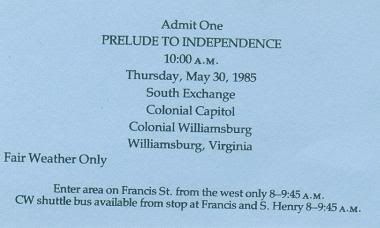
Prelude to Independence ticket

My dad could have taken my mom or even another friend, but he checked with my school and was able to have this counted as a field trip, as long as I would write about it for my history class.

So, on Thursday morning, May 30th, 1985, my dad and I put on coat and tie and drove from our home in Poquoson, VA to Colonial Williamsburg. I was overwhelmed by the security. I remembered about the attempt on Reagan’s life in DC, but I never really expected to have to be screened in such a way. I had to show my military dependent ID and my student ID. I had to let them frisk me and run the wand around me to ensure I wasn’t dangerous. As a 16 year old, whose thoughts were normally on rock and roll and the fairer sex, I was getting a bit agitated. But there wasn’t a way I could tell my dad to get us out of there.

Mind you, my parents have always been conservative in their politics. They never really talked about who they voted for but mainly about the issues of the day. At that time, I was discovering my love for practicing and performing music and was starting to set my goals in that direction. My dream was to replace Doc Sevrinsen on the Tonight Show. So Politics and politicians never really spoke to me….at least I never really wanted to hear them. Then along came Ronald Reagan. With him as President, I began to see a love of country and pride in what America could do. Yet I was still too young to vote so I just went along with the good feeling.

Back to Williamsburg in 1985. It was a warm and sunny morning and in my coat and tie, I was sweating. We got there early and had been seated and waiting for over an hour. My dad did his best to engage me with conversation about things of family and school but I was getting impatient. Then the announcement came and President Reagan took the dais.

Ronald Reagan spoke of his tax proposal for this new term. There were points made that inspired pride and points that brought laughter. He was the great communicator after all.

As I stated above, I was to write something for my history class. Well, taxes weren’t inspiring me much. After all, my measly after school and weekend yard work job was under the table, so I never saw anything taken away from me yet. I worked hard and was paid.

Then President Ronald Wilson Reagan said something that struck me to my core. In fact, I heard his words and they echoed around my noggin again and again. I still remember those words to this day:

“Our forefathers fought a revolution for two reasons: to give liberty to a naturally independent people and to secure, in the words of a Burgess who met here, ‘...Prosperity in the Community and Security to Individuals.’ The idea of freedom impelled them; it intoxicated them. And it is freedom that impels us still.”


WOW!!!!

Taxes started to mean something to me; politically, historically, and PERSONALLY!

I had a new respect for what my dad did and that he was working hard to not only support his family but to have his money taken away from him to support the government as well.

I realized then that republicanism was for the PEOPLE and liberalism was for the government. I knew what I wanted to write for school. I don’t remember exactly what it was but it started with the quote above and continued with the history of federal taxation. And I believe my final statement was something on the order of: Prosperity and security have to go hand in hand in America. This nation can only survive and succeed if we take them as equals and not sacrifice one for the other by over taxing the population.

From that moment on, I knew that I was a conservative when it came to politics. I knew that when I went into the ballot box for the first time in 1988, that my vote wasn’t just for me but for the nation and for America’s place in the world.

-SK

------------------------------------------------
Remarks at the "Prelude to Independence" Celebration in Williamsburg, Virginia
May 30, 1985


Thank you, ladies and gentlemen, Governor Robb, Senator Trible, Mayor Walker, and distinguished members here of the Williamsburg Foundation, the officials of that organization, and you ladies and gentlemen.

It is very good to return to this city which is so closely associated with the birth of the American Republic. Boston is called the Cradle of Liberty, Philadelphia is where the Liberty Bell first rang, but Williamsburg, too, has an honored place in our history and our hearts. Because, as you have been told, here a practical plan for American self-government and a declaration which became the basis for the Bill of Rights of our Constitution were written, endorsed, and sent out to the world by the Virginia Legislature.

Here the arguments against unjust taxation rang out like a firebell in the night, and the chief arguer, Patrick Henry, gave our movement for independence the one thing it needed to become a revolution -- he gave it passion.

And here, through long hours of great debate in the capitol behind me, the people of the colony evolved irresistibly from British subjects to American patriots.

And so, I'm happy and honored to speak in Williamsburg today. For I, too, mean to speak of liberty and a practical plan to increase its measure in our country. I wish to speak also of the philosophical underpinnings of that plan, for whatever happens to it, I mean for it to be understood.

Two nights ago I unveiled our proposal to revolutionize the Federal tax code. I spoke of the system as it is now, and as we wish it to be. But just for a moment today I want to note how our modern tax system evolved from a modest attempt to raise modest revenues to the behemoth to which we are currently beholden.

The Federal income tax only began in 1913. At that time some strange things happened. When it was being debated in the Congress one man spoke prophetically -- or I should say, very honestly when he said, ``We don't need this tax for government's needs. We need it for government's wants.'' And he was pretty prophetic, but there was another man that was almost laughed out of public life and public office, a Senator who said, ``If we pass this amendment, we may very well see the day when the government could think it could take as much as 10 percent of a person's earnings.'' [Laughter] They thought that was a pretty ridiculous statement.

Well, this income tax was instituted because the Federal Government needed more money to operate because there was a widespread feeling that the rich ought to contribute to the system that made their riches possible. It was a system aimed almost exclusively at the wealthy, a class tax, as opposed to a mass tax.

The first tax rates were low. The 1913 income tax imposed a top personal rate of 6 percent. And you had to report an income of more than a half a million dollars a year to pay it. The poor and the middle class paid nothing. The personal exemption was $3,000. Now you know why they're called ``the good old days.'' [Laughter]
During the First World War tax rates were increased, but they were relaxed again during the 1920's. Right up until the eve of World War II, the Federal income tax was still a tax limited to the wealthy. It affected only 4 or 5 million people, and their taxes yielded, in all, less than 20 percent of the Nation's revenues.

But during and after the war a great change came -- tax rates were increased, exemptions were reduced, and inflation brought more people into the tax structure. Withholding was introduced for the first time, and suddenly just about every working American was paying the Federal income tax. And the tax suddenly was the largest single component of government revenues.

What followed, we know too well -- the tax system began to grow and grow, rates were pushed higher, more and more people found themselves paying more and more money. Ironies abounded. As the tax system grew bigger and more powerful, it also grew more incompetent. And as it demanded more to pay for programs to better our lives, it became more heartless.

Seventy-two years after its inception, what is our Federal tax system? It's a system that yields great amounts of revenue, yes, but even greater amounts of discontent, disorder, and disobedience. It's a system in which the top personal tax rate rose to 94 percent. And it only came down from those heights when a young man named John Kennedy decided some time back that while it's all right for the Federal Government to be your partner, it's not quite fair that he be your boss.

It's a system from which no full-time wage earner is exempt. Now, almost everyone, no matter what their circumstances or their special needs, must pay. In fact, so many pay so much that someone has figured out that it takes the average taxpayer until almost May every year before he starts working for himself. Up till then, he's working for the government.

It's a system that allows an exemption of barely over $1,000 a year for each child born into a family, an exemption so utterly out of touch with the realities of everyday life that it serves as a metaphor for exactly how ridiculous the entire structure is.

It's a system that increasingly treats our earnings as if they were the personal property of the Government, with decent citizens called before the Internal Revenue Service to answer for their income and expenditures and show their papers and their proof in a drama that is as common as it is demeaning. Wasn't there a line a couple of hundred years ago about being safe in your books and your records?

Well, it's a system so utterly complex and ultimately inexplicable that half the time the tax professionals themselves aren't sure what the rules are -- a system that even Albert Einstein is said to have admitted he couldn't begin to fathom. You know, it's said that his hair didn't look that way until after he experienced his first tax form. [Laughter]

It's a system that is antigrowth and antiproductive for it discourages the very virtues that make a man and woman valued contributors to society. You know this if you've ever worked overtime to pay for your child's braces. The money you earn is taxed at so high a rate as to render your extra efforts almost totally without point or profit.

It is, finally, a system whose most serious sin may be its most subtle for it seems so rigged, so unfair, that it corrupts otherwise honest people by encouraging them to cheat.

Thirty and forty years ago you didn't hear people brag at social get-togethers about how they got their tax bill down by exploiting this loophole and engineering that credit. But now you do. And it's not considered bad behavior. After all, goes this thinking, what's immoral about cheating a system that is itself a cheat? That isn't a sin, it's a duty.

Our Federal tax system is, in short, utterly impossible, utterly unjust, and completely counterproductive. It's earned a rebellion, and it's time we rebelled.

We must move and move now for all the reasons I've named and more. The current system just doesn't work anymore. The underground economy and the cult of cheating prove that this is so. What to do? Well, we took our first step toward a second American revolution in 1981 when we lowered tax rates for every individual in this country. This increased our economic freedom and sparked one of the greatest economic expansions in our nation's history.

But now is the time to take the second step, the historic step for America's tax plan. Now is the time to turn our tax system around once and for all and make it more just, more equitable, more comprehensible. Now is the time to create a tax system that will encourage and not penalize the creation of wealth and jobs. Now is the time, in short, to get the Federal Government off our backs and out of our way.
You're familiar with our plan. We propose to simplify the rate structure down to just three rates -- 15, 25, and 35 percent. We propose to increase the personal exemption by almost a hundred percent, from just over $1,000 to $2,000 for every taxpayer and dependent with a provision to increase it still more if inflation occurs. We propose to end unproductive tax shelters so that no one will be able to hide in the havens that privilege builds. But we will retain those few tax advantages that speak directly to how Americans live their lives and how the American economy operates. For instance, the mortgage interest deduction stays for the house that you own and live in, and along with that, no less than $5,000 in other interest expenses would still be deductible.

We propose to lower the top corporate income tax rate from the current 46 percent to 33 percent, and we've proposed a new minimum tax to deal with those corporations and individuals that have managed not to pay any tax at all.

Now, you might see the present tax structure as a hornet's nest. Our plan is an attempt to burn away the webs and the nest and let the Sun shine in to start new, start clean, and start over. Is this long overdue reform revolutionary? I believe it is, but we conservatives don't launch revolutions lightly. There must be a clear and compelling need, and the reform that's proposed must bear within it the promise to better the lives of all of our citizens, and the reform must be achievable.

Well, our tax reform plan of 1985 satisfies those requirements. Beyond that, it will go a long way towards satisfying America's hunger for justice, thirst for opportunity, and search for freedom. By lowering the highest tax rates on individuals and businesses, we encourage the growth of our economy. Lower tax rates, of course, increase the after tax wages for additional work. And so, people will be able to profit once again from working overtime or at a second job. Lower tax rates will also increase the aftertax return on savings and investment. And so, people will tend to save and invest more. This will provide the money the economy needs to build additional factories or buy more machinery.

These are not just economic facts. What I am speaking about is a profound public good. For when a society has high levels of economic growth, most everyone benefits, especially the poor. More jobs are created, there's more money to spend on medical care and education, the standard of living increases, and all of this enhances the quality of life.

By simplifying the rate structure itself and by eliminating the devices by which the powerful evade their responsibilities, we ensure that people in the same circumstances will pay the same levels of tax. We'll ensure that those now earning lower incomes will not find themselves paying a greater percentage of their income in taxes than those earning higher incomes. We'll ensure that from the hard streets of the cities to the soft green hills of the suburbs the people of America will pay their fair share and no more.

So, I believe the virtues of our proposal are clear. You'll know that your neighbor is paying roughly what you are, that no one will be able to rig the system to his benefit. You'll know that the tax rates themselves won't creep up and mug you just as you start to succeed in the world. And we'll all know that those least able to pay will pay little or nothing.

But what is the broader purpose of our tax proposal? Well, I'm glad to be standing in front of the House of Burgesses as I address that question. The members who spoke in this capital said no to taxes because they loved freedom. They argued, ``Why should the fruits of our labors go to the Crown across the sea?'' Well, in the same sense, we ask today: Why should the fruits of our labors go to that Capitol across the river?

You know, we have a saying among some of us there in Washington: We're going to stick to it. If I sound like I'm talking about government as something else, I am. When we who are now there start talking about government as ``we'' instead of ``they'' we've been there too long. [Laughter]

When you read our tax code you realize that somehow we got lost along the way. Somewhere along the line, we stopped understanding that people worked not for the government, but for themselves; that they get up every morning and go out into the world to earn their bread, not to support a government, but to support their families. We, the citizens of the United States, have got to get public law back in line with private imperatives.

I see all of you out here and I'm sure that most of you have a wallet in your pocket or your purse. Just think of what you have in that wallet, how you earned it, and what you want to spend it on. That's your money. That's your effort. That's your freedom there. The disposition of that money belongs, by rights, to you.

I want a tax system that keeps as much of that money in your wallet as possible. The primary reason is moral. It's your money, after all. But the secondary reason is practical. You'll do more for the economy with it, and you'll do more to benefit your fellow citizen with it than the government will.

Now, I'm going to be speaking a great deal about tax reform over the next few weeks and months. And I expect it to be challenging. It's a shrewd turn of the American people that, when you announce a plan to help them, they stand back and scrutinize it and approach with a question: Now, how are you going to hurt me this time? [Laughter] Well, this is not an unreasonable question. So many times the American people have been promised better and been delivered worse. But I tell you from the bottom of my being, this is a plan that's going to help our country by helping every individual in it.

Our tax proposal will not increase the deficit; it is revenue neutral. It is not a tax increase; in fact, it's designed to be the first step toward lower tax rates in the future. When you simplify a thing, make its lines clear and clean, you make it much less vulnerable to quiet mischief and selfish tinkering. So, if some Congress of the future gets it in its head to increase taxes -- to raise the lowest personal tax rate from 15 percent to something higher -- the public will immediately see what is happening and understand what is happening. And they will rise up and resist, and they will be heard.

In a way what I'm trying to say is an unclean, unsound structure is vulnerable to mischief. When the house is a mess and everything's chaos, you're not likely to notice when something is missing. But when the house is clean and designed with balance you tend to notice if somebody tries to cart off the furniture. [Laughter]

Our forefathers fought a revolution for two reasons: to give liberty to a naturally independent people and to secure, in the words of a Burgess who met here, ``. . . Prosperity in the Community and Security to Individuals.'' The idea of freedom impelled them; it intoxicated them. And it's freedom that impels us still.

History's not a static thing. History moves; it never stops. And the American Revolution continues as we continue to push back the barriers to freedom. We, like the patriots of yesterday, are struggling to increase the measure of liberty enjoyed by out fellow citizens. We're struggling, like them, for self-government -- self-government for the family, self-government for the individual and the small business and the corporation.

And so, we offer this tax proposal of 1985 in the name of growth and fairness. We offer it to ensure generations of economic power for the citizens of this free and vital nation. We're doing it in the name of our children, and we're doing it in the memory of those towering souls who walked these streets and met in this capitol and together wrested justice from the heart of oppression. We offer this plan in memory of the patriots who took a handful of demoralized little colonies and invented a nation. We're doing it to continue their work.

I ask for your help. Without it, nothing can be accomplished; but with it, everything is possible. And so, in the truest sense, this great effort -- America's tax plan -- is in your hands. And for that I'm truly thankful. And I can only urge: America, go for it!

Thank you. Thank you, and God bless you. And thank you for inviting me. It's been wonderful to be here.

Thank you very much.


Note: The President spoke at 10:36 a.m. at the Colonial Capitol Building. The Colonial Williamsburg Foundation sponsored the celebration.

Monday, August 11, 2008

FYI

"God grants liberty only to those who love it and are always ready to guard and defend it," - Daniel Webster

Friday, June 13, 2008

History of the Star Spangled Banner

God: Missing in Action from American History

God: Missing in Action from American History

David Barton - 06/2005

(First published in the June 2005 issue of The NRB Magazine)


American history today has become a dreary academic subject. Yet, most who are bored by American history view Bible history quite differently: they love the stories of David and Goliath, Daniel and the lion's den, and Peter walking on the water. So it's not that people don't enjoy history, it's just that they don't respond favorably to the way American history is currently being taught.

One reason Bible history is interesting and American history is not is that the Bible (as well as American education during its first three centuries) utilizes biographical history - that is, it presents history through the eyes and life experiences of those involved (i.e., the biographies) rather than through the recitation of a string of dates and places. It is the difference between reading the stories in Guideposts and the numbers in a phone book.

Looking at history the way God presents it is exciting and informative; and in numerous verses, God even commends its study:

"Remember the former things of old: for I am God" (Isaiah 46:9)
"Call to remembrance the former days" (Hebrews 10:32)

But why would God want us to know history? The Apostle Paul answers that question in 1 Corinthians 10:1: "All these things happened unto them for example; and they are written for our admonition" (see also Romans 15:4: "Those things written aforetime were written for our learning"). In short, we learn from history; and what we learn affects our behavior.

American leaders long understood this Biblical truth. For example, Thomas Jefferson noted: "History, by apprizing them [students] of the past, will enable them to judge of the future." And what can be learned by being "apprized of the past"? According to Benjamin Franklin: History will afford frequent opportunities of showing the necessity of a public religion from its usefulness to the public; the advantage of a religious character among private persons; the mischiefs of superstition; and the excellency of the Christian religion above all others, ancient or modern.

Franklin understood that history, when accurately presented, would demonstrate the need for Christianity because of both the societal and the individual benefits it produces. In fact, the presenting of an uncensored and unrevised history actually causes a recognition of the hand of God - for, in the words of the great statesman Daniel Webster: "History is God's providence in human affairs."

Today, however, history is presented in such an edited, revised, and politically-correct manner that God's hand is rarely visible - and even the historic role of famous Godly leaders in education, business, politics, and the military is now virtually unacknowledged.

An obvious example of the secularization of history occurs each year around the Fourth of July. Americans are taught that "taxation without representation" was the reason America separated from Great Britain; yet "taxation without representation" was only reason number seventeen out of the twenty-seven reasons given in the Declaration of Independence - it was not even in the top half, yet it's all that most ever hear. Never mentioned today are the numerous grievances condemning judicial activism - or those addressing moral or religious or other issues.

What religious issues? In 1762, the king vetoed the charter for America's first missionary society; he also suppressed other religious freedoms and even prevented Americans from printing an English language Bible. How did Americans respond? They took action; and almost unknown today is the fact that Declaration signers such as Samuel Adams and Charles Carroll cited religious freedom as the reason they became involved in the American Revolution. And significantly, even though Thomas Jefferson and Ben Franklin (two of the least religious signers) are typically the only signers studied today, almost half of the signers of the Declaration (24 of 56) held what today would be considered seminary or Bible school degrees. Clearly, for many Founders, religious issues were an important motivation behind their separation from Great Britain; but that motivation is largely ignored today.

Moral issues are accorded the same silence. The greatest moral issue of that day was slavery; and after several of the American colonies moved toward abolishing slavery in 1773, the King, in 1774, vetoed those anti-slavery laws and continued slavery in America. Soon-to-be signers of the Declaration Benjamin Franklin and Benjamin Rush promptly founded America's first abolition society as a direct response against the king's order. The desire to end slavery in America was a significant motivation not only for Franklin and Rush but also for a number of others; but the end of slavery in America could be achieved only if they separated from Great Britain - which they were willing to do (and six of the thirteen colonies began abolishing slavery following the separation).

There were many other significant issues that led to our original Fourth of July; so why aren't Americans familiar with the rest? Because in the 1920s, 30s, and 40s, a group of secular-minded writers (including Charles and Mary Beard, W. E. Woodward, Fairfax Downey, and others) began penning works on American history that introduced a new paradigm. For this group, economics was the only issue of importance, so they began to write texts accordingly (their approach is now described as "the economic view of American history" and since the 1960s has been widely embraced throughout the education community). Consequently, since "taxation without representation" was the economic grievance in the Declaration, it became the sole clause that Americans studied.

As a result, God is no longer visible in American history; and His absence is now construed as a mandate for secularism. Texts now forcefully assert that the American founding produced the first intentionally secular government in history - even though the Declaration officially acknowledges God in four separate clauses. (But who still teaches the Declaration - or even reads it?) Similarly, leaders such as John Hancock and John Adams receive credit as being the source of our independence, even though John Adams himself declared that the Rev. Dr. Jonathan Mayhew and the Rev. Dr. Samuel Cooper were two of the individuals "most conspicuous, the most ardent, and influential" in the "awakening and revival of American principles and feelings" that led to American independence. Regrettably, God (and His servants) have largely disappeared from the presentation of American history in general and America's founding in particular.

As a further example, consider the legendary Minutemen: even though they are still honored in many texts, their leader, the Rev. Jonas Clark, is no longer mentioned - nor the fact that many of the Minutemen were deacons in his church. And the Rev. James Caldwell is no longer acknowledged as a key leader of military forces in New Jersey - nor the Rev. John Peter Gabriel Muhlenberg (who led 300 men from his church against the British) as one of Washington's most trusted generals.

Regrettably, we no longer know much about the indispensable role of pastors and Christian leaders in the founding of our civil government. Americans have been subjected to "revisionism" - defined by the dictionary as "the revision of an accepted, usually long-standing view; especially a revision of historical events and movements." Revisionism attempts to alter the way a people sees its history in order to cause a change in public policy.

Consider how successful this has been. Under the economic view of American history, Americans now believe that the early colonists came to America seeking land and gold rather than for the reason most cited by the colonists: evangelization. And most now accept that the colonies were founded for trade, fishing, and other economic enterprises, even though more than half were founded by Gospel ministers for religious purposes (e.g., Massachusetts, New Hampshire, Connecticut, Rhode Island, Georgia, etc.). And if religion is discussed in a text, it will be to present the 21 deaths during the Salem Witch Trials rather than the Great Awakenings, the Civil War revivals, or the turn-of-the-century revivals that led to widespread urban renewal and the end of child labor.

Having now come to believe that economics is what created and made America great, it is not surprising that few Americans commented on the fact that, during the 2004 presidential debates, "jobs" and "economy" were mentioned hundreds of times but "marriage" less than a dozen. Nor is it surprising that over the past decade, 45 percent of evangelical Christians say that economic issues are more important than moral issues when it comes to voting.

There is so much of our wholesome, God-centered American history that we no longer know today. This is especially true when it comes to the average American's knowledge of African American history.

Consider, for example, African American achievements during the American Revolution. Few today know that almost 5,000 of the patriots in the fledgling Continental Army were African Americans - that, for example, a hero of the Battle of Bunker Hill was African American Peter Salem. His heroic actions saved the lives of scores of Americans, and he was honored before General Washington for his courage.

And Pastor Lemuel Haynes was involved in several major Revolutionary battles and became an ardent admirer of George Washington, regularly preaching sermons on Washington's birthday. This patriot preacher was the first African American to be ordained by a mainstream Christian denomination (the Congregationalists, in 1785), to pastor a white congregation (a congregation in Connecticut), and to be awarded an honorary Master's Degree (by Middlebury College, in 1804). Yet who today has heard of Lemuel Haynes?

Or who has heard of James Armistead, the courageous spy at Yorktown whose remarkable service considerably shortened the War? Or Oliver Cromwell and Prince Whipple (depicted in several famous Revolutionary War paintings) who served directly under General Washington and the general staff? Or Jordan Freeman, the gallant soldier to whom a monument was erected for his heroic service at the Battle of Groton Heights?

Then there is also African American church history - including the amazing story of the Rev. John Marrant, the first African American to evangelize successfully among American Indians; the Rev. Richard Allen, who gained his freedom from slavery, served in the American Revolution, became a preacher in a church of 2000 whites, and founded America's first black denomination; and the Rev. Harry Hoosier, who delivered the first recorded Methodist sermon by an African American and drew crowds larger than the great Methodist Bishop Francis Asbury.

And consider African American political history. Who today knows the story of the Rev. Hiram Rhodes Revels, the African American missionary who became the first black U. S. Senator? Or the Rev. Henry Highland Garnet, the first African American to deliver a sermon in Congress? Or Joseph Hayne Rainey, who overcame slavery to become the first African American elected to the U. S. Congress, even presiding over the U. S. House? (In the picture of the first seven African Americans elected to the federal Congress - all as Republicans - the Rev. Revels is the first from the left, and Rainey is second from the right.) Or who today has learned that nearly every southern Republican Party was started by African Americans - or that the first 190 African Americans elected to office in South Carolina (and the first 112 in Mississippi, the first 42 in Texas, the first 127 in Louisiana, etc.) were all Republicans, and many were ministers?

I have spent years collecting thousands of original and priceless documents from American history in general and black history in particular; God's fingerprints are evident throughout. I have been asked why I, as an Anglo, would spend so much time in the study of African American political history. The answer is simple: I am an American; and since the story of African American history is part of American history, it therefore is part of my own history. Furthermore, I am inspired by all stories of sacrifice, courage, and Godly character - regardless of skin color. The stories of African American heroes such as Phillis Wheatley, Francis Grimke, and John Roy Lynch are as thrilling to me as are the stories of Lewis & Clark, Helen Keller, and Alvin York.

The reintroduction of a truthful and complete telling of American history is long overdue. Daniel Webster was right: "History is God's providence in human affairs," and it is time for Americans once again to become aware of the remarkable hand of God throughout our history.